






ORGANS OF PARIS © 2026 Vincent Hildebrandt HOME ALL ORGANS



Saint-Jacques-du-Haut-Pas takes its name from the
Hospitaller brothers who came from Italy to Paris in
the 12th century. The church origins go back to a
chapel built in 1533 and later expanded to its present
form in the 17th century.


D2
1628
The first organ was built by organ builder and resident
organist Vincent Coppeau.
1744
Organ builder François Thierry replaced Coppeau’s instrument
with a new organ featuring three manual keyboards. However,
little is known about its detailed history or specifications. It
remained in use until 1792, when the organ was sold.
1792
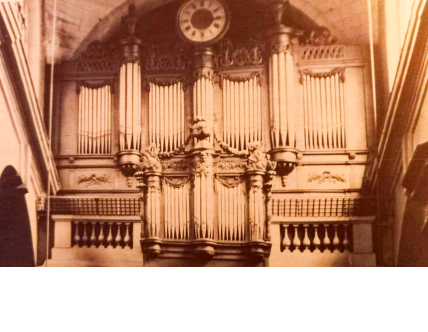
The city of Paris offered the parish the case from the nearby
collegiate church of Saint-Benoît-le-Bétourné (now vanished).
Claude-François Clicquot was commissioned to transfer and
reconstruct a new instrument (33 stops / 4 manuals) within the
historic case. A new gallery was built, and the main case was
widened. Certain parts of the case date back to 1586, making
Saint-Jacques-du-Haut-Pas partly home to the oldest surviving
organ case in Paris.
1969–1971
In 1964, a decision was made to build a new organ in the style
of the “Alsatian syntheses,” inspired by the recently
inaugurated organ of Saint-Séverin in Paris — designed to
meet both the stylistic needs of German music and those of
the French classical organ tradition, following the approach
initiated long ago by André Silbermann.
A full restoration of the organ case — a witness to three
centuries of successive modifications — accompanied the
rebuilding of the instrument itself. Some of the existing
pipework was retained, where it could blend naturally into the
new conception of the instrument without compromising its
integrity.
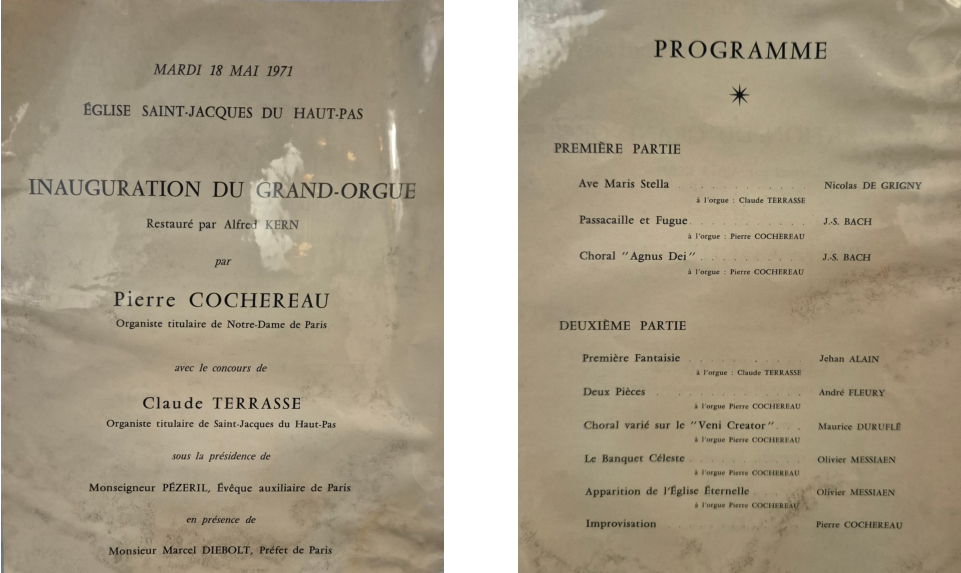
The new windchests were made by Kern (1969–1971), with
mechanical slider chests and pallets. The window-style console
was also rebuilt by Alfred Kern.
1987
Alfred Kern & Sons carried out maintenance work and, at the
request of resident organist Nicolas Gorenstein, replaced the
4′ Clairon on the Récit (by Merklin) with a new 16′ Douçaine, to
create a proper “16′–8′–4′ battery” on that manual.
Historic stops
Stops dating from the 18th century:
•
Cornet V ranks (G.O., starting at middle C₃)
•
Pedal Trompette and Clairon
Stops by Merklin:
•
Positif: Wood pipes of Bourdon 8
•
Grand-Orgue: Montre 8, wood basses of Bourdon 16 and
Bourdon 8, Double Nasard, Voix humaine
•
Récit: Trompette
•
Écho: Hautbois
•
Pedal: Flutes 16, 8, 4
History of the former organ of Saint-Jacques-du-
Haut-Pas
1792–1793
After the organ of Saint-Benoît was assigned to the
parish of Saint-Jacques, a suitable gallery was built,
making it possible to install the case without major
alterations (only a slight widening). Claude-François
Clicquot took the opportunity to complete the pedal
division.
1803
Maintenance work carried out by Dallery.
1887–1889
The instrument was rebuilt by Merklin. He emptied
the Positif and aimed to equip the organ with the
brand-new electro-pneumatic “Schmoële & Mols”
system, with an ambitious plan to link the main organ
and the choir organ. The gallery organ was to have 29
stops and the choir organ 15, both playable either
together or separately from a single four-manual
console located in the choir. Some of the pipework
was reused, but, in keeping with the practices of the
time, the wind pressure was increased.
1906–1908
Improvements to this rather unreliable system were
entrusted to Gutschenritter. He combined electricity
with a tubular system, creating a new type of electro-
pneumatic action considered innovative at the time.
He lowered the wind pressure and slightly revoiced
the instrument, adjusting the stoplist: adding a Flûte
douce 4’ on the Grand Orgue, and a Gambe 8’ and
Clairon 4’ on the Récit.
The gallery organ and the choir organ remained
linked: a single four-manual console, placed in the
choir behind the altar, allowed both instruments to be
played either separately or together. This solution,
attractive in theory, did not take into account the
significant acoustic delay, which made playing the
gallery organ from the choir difficult and risky. To
address this, around 1920 the organist Achille Philip
had a second console installed on the gallery.
Despite a sound initial design, the electrical
transmission gradually deteriorated, making the
instrument almost unplayable.
1958
Maintenance work carried out by Probst père et fils
brought only a temporary improvement to the worn
electro-tubular action. Shortly afterwards, the
connection with the choir organ was removed, along
with the shared console, but by then the instrument
had become virtually unplayable.


Buffet 1587-1640-1655-1792-1971
1971 - Alfred Kern (3)
1987 - Alfred Kern et fils (6)
IV/47 - mechanical traction
Stoplist
Titular organist
Patrice Holiner
Parish website
Video
Patrice Holiner
Photo:
Buffet : Jeroen de Haan
Eglise : Vincent Hildebrandt
History of the instrument of the former Collegiate Church
of Saint-Benoît-le-Bétourné (Paris)
1586–1587
The organ was commissioned from the Flemish builder Jean
Langhedul, while the case was entrusted to the cabinetmaker
Claude Delaistre. It was a small 4-foot organ with a single
manual of 45 keys and a pedalboard coupled to the manual.
The instrument was overhauled and enlarged at the beginning
of the 17th century by Mathieu Langhedul, son of the original
builder, and later by Nicolas Pescheur.
1640
The organ was fitted with a second manual for a rear Positive
of 3-foot pitch in the façade.
1655
Enlargement by Guy Jolly, including modifications to the main
case. The work he left unfinished was completed by P.
Cauchois: reworking of the Grand Orgue with the addition of a
16' Bourdon, installation of a third manual (Écho), and
extension of the pedalboard to 29 notes.
1673
A new campaign of work was entrusted to the Thierry brothers
(addition of a two-rank Cymbale on a new Positive
soundboard, and replacement and relocation of the bellows).
1687
The organ was dismantled when the gallery was rebuilt. When
it was reassembled by Ducastel and Bessart, it had grown to
four manuals and 31 stops, reaching the classical ideal within
the limits of its size.
1767–1784
A major rebuilding project entrusted to Nicolas Somer was
interrupted by his death during the work. It was then
continued by François-Henri Clicquot in two successive phases:
rebuilding of the main soundboard, addition of a fifth manual
(Bombarde), changing the Positive façade stop to 8-foot pitch,
enlargement of the keyboards, and more. By 1784, the
instrument that emerged from Clicquot’s workshop was
virtually new, and soon became available following the closure
of Saint-Benoît.








The organs of Paris


ORGANS OF PARIS © 2026 Vincent Hildebrandt

D2
1628
The first organ was built by organ builder and resident
organist Vincent Coppeau.
1744
Organ builder François Thierry replaced Coppeau’s instrument
with a new organ featuring three manual keyboards. However,
little is known about its detailed history or specifications. It
remained in use until 1792, when the organ was sold.
1792
The city of Paris offered the parish the case from the nearby
collegiate church of Saint-Benoît-le-Bétourné (now vanished).
Claude-François Clicquot was commissioned to transfer and
reconstruct a new instrument (33 stops / 4 manuals) within the
historic case. A new gallery was built, and the main case was
widened. Certain parts of the case date back to 1586, making
Saint-Jacques-du-Haut-Pas partly home to the oldest surviving
organ case in Paris.
1969–1971
In 1964, a decision was made to build a new organ in the style
of the “Alsatian syntheses,” inspired by the recently
inaugurated organ of Saint-Séverin in Paris — designed to
meet both the stylistic needs of German music and those of
the French classical organ tradition, following the approach
initiated long ago by André Silbermann.
A full restoration of the organ case — a witness to three
centuries of successive modifications — accompanied the
rebuilding of the instrument itself. Some of the existing
pipework was retained, where it could blend naturally into the
new conception of the instrument without compromising its
integrity.
The new windchests were made by Kern (1969–1971), with
mechanical slider chests and pallets. The window-style console
was also rebuilt by Alfred Kern.
1987
Alfred Kern & Sons carried out maintenance work and, at the
request of resident organist Nicolas Gorenstein, replaced the
4′ Clairon on the Récit (by Merklin) with a new 16′ Douçaine, to
create a proper “16′–8′–4′ battery” on that manual.
Historic stops
Stops dating from the 18th century:
•
Cornet V ranks (G.O., starting at middle C₃)
•
Pedal Trompette and Clairon
Stops by Merklin:
•
Positif: Wood pipes of Bourdon 8
•
Grand-Orgue: Montre 8, wood basses of Bourdon 16 and
Bourdon 8, Double Nasard, Voix humaine
•
Récit: Trompette
•
Écho: Hautbois
•
Pedal: Flutes 16, 8, 4
History of the former organ of Saint-Jacques-du-Haut-Pas
1792–1793
After the organ of Saint-Benoît was assigned to the parish of
Saint-Jacques, a suitable gallery was built, making it possible
to install the case without major alterations (only a slight
widening). Claude-François Clicquot took the opportunity to
complete the pedal division.
1803
Maintenance work carried out by Dallery.
1887–1889
The instrument was rebuilt by Merklin. He emptied the Positif
and aimed to equip the organ with the brand-new electro-
pneumatic “Schmoële & Mols” system, with an ambitious
plan to link the main organ and the choir organ. The gallery
organ was to have 29 stops and the choir organ 15, both
playable either together or separately from a single four-
manual console located in the choir. Some of the pipework
was reused, but, in keeping with the practices of the time, the
wind pressure was increased.
1906–1908
Improvements to this rather unreliable system were
entrusted to Gutschenritter. He combined electricity with a
tubular system, creating a new type of electro-pneumatic
action considered innovative at the time. He lowered the
wind pressure and slightly revoiced the instrument, adjusting
the stoplist: adding a Flûte douce 4’ on the Grand Orgue, and
a Gambe 8’ and Clairon 4’ on the Récit.
The gallery organ and the choir organ remained linked: a
single four-manual console, placed in the choir behind the
altar, allowed both instruments to be played either
separately or together. This solution, attractive in theory, did
not take into account the significant acoustic delay, which
made playing the gallery organ from the choir difficult and
risky. To address this, around 1920 the organist Achille Philip
had a second console installed on the gallery.
Despite a sound initial design, the electrical transmission
gradually deteriorated, making the instrument almost
unplayable.
1958
Maintenance work carried out by Probst père et fils brought
only a temporary improvement to the worn electro-tubular
action. Shortly afterwards, the connection with the choir
organ was removed, along with the shared console, but by
then the instrument had become virtually unplayable.
Buffet 1587-1640-1655-1792-1971
1971 - Alfred Kern (3)
1987 - Alfred Kern et fils (6)
IV/47 - mechanical traction
Stoplist
Titular organist
Patrice Holiner
Parish website
Video
Patrice Holiner
Photo:
Buffet : Jeroen de Haan
Eglise : Vincent Hildebrandt

History of the organ of the former Collegiate Church of
Saint-Benoît-le-Bétourné (Paris)
1586–1587
The organ was commissioned from the Flemish builder Jean
Langhedul, while the case was entrusted to the carpenter
Claude Delaistre. It was a small 4′ organ with a single 45-note
keyboard and a coupled pedalboard. The instrument was
refurbished and expanded in the early 17th century by
Mathieu Langhedul, son of the builder, followed by Nicolas
Pescheur.
1640
The organ was given a second keyboard for a Positif de dos
(rear positive) with a 3′ Montre.
1655
Enlarged by Guy Jolly, with modifications to the main case. The
unfinished work was completed by P. Cauchois: the Great
Organ was revised and equipped with a 16′ Bourdon, a third
Écho keyboard was added, and the pedal was extended to 29
notes.
1673
A new round of work was commissioned from the Thierry
brothers (installation of a two-rank Cymbale on a new Positif
chest, replacement and relocation of the wind system).
1687
The organ was dismantled when the gallery was replaced.
During reassembly by Ducastel and Bessart, the instrument
was expanded to four manuals with 31 stops — reaching the
classical ideal within the limits of its size.
1767–1784
A major overhaul entrusted to Nicolas Somer was interrupted
by his death while the work was underway. It was resumed by
François-Henri Clicquot in two successive phases: renewal of
the main windchest, addition of a fifth Bombarde manual,
conversion of the Positif Montre to 8′, and enlargement of the
keyboards. By 1784, the organ emerging from Clicquot’s hands
was practically a new instrument — soon made available when
Saint-Benoît was deconsecrated.
